Sunday, September 27, 2015

A Blended Approach to Vocabulary

My school is focusing on vocabulary instruction this year with the hope of increasing academic gains in several areas. To that end, I was asked to design an inservice with one of my colleagues for our staff to show how we could use blended learning tools to discretely teach vocabulary this year. Because my standard vocabulary approach had been to merely tell my students the meaning of a word and then keep teaching, I was surprised to be asked to lead this one. Still, I viewed it as a chance to learn something new and dove in. Last week completed the seventh session of this professional development that included an introduction to vocabulary instruction, a station rotation of Marzano strategies, and vocabulary centers.


Our first portion of the inservice introduced the idea of tiered vocabulary. We used Pear Deck to acquaint our peers with Tier 1, 2, and 3 vocabulary words. Tier 1 words are words the students come to us knowing. Tier 3 words are the content-specific words we already teach. Tier 2 words are powerful tweeners, the words that cross curricula, have multiple meanings, and provide a specificity in meaning. Our hope is that teachers will focus more of Tier 2 words this year.

The second segment of our inservice was a station rotation where each participant was assigned a challenging word (pulchritude does not sound like what it means!) and then worked through a set of Marzano strategies to learn that word and many others. On slides, we wrote friendly definitions, chose images, wrote synonyms and antonyms, and had a conversation with these words. Then all the words we presented by participants. We finished with a game. For our game, we used Speed Match by SuperTeacherTools. Want to try your hand at this game or just see what speed match is? Check it out here. It was VERY easy to create!

 Our third portion of the inservice allowed our colleagues a lot of flexibility in path, pace, and place as they explored our vocabulary centers. With ten different vocabulary tools at the centers, everyone had the opportunity to explore many strategies or focus on one in great detail. Overall, our inservice was well-received and our peers reported that they left with many ideas about what and how to teach vocabulary this year. Many people worried, though, that adding vocabulary instruction could take too much time, or at least take time away from something else.

In the category of "practice what you preach," I wanted to raise my vocabulary instruction without sacrificing too much time. Because I had never really done any vocabulary instruction before now, I acknowledge that anything would be better than my status quo. When it was time to review my first unit, I used a quick strategy to highlight some Tier 2 words from introductory chemistry. My students, working in pairs, were assigned a Tier 2 word. They had to write a sentence that showed how the word was used in chemistry, write a sentence that showed how the word might be used outside of chemistry, and then explain a similarity between the two sentences. They did this with dry erase markers on the glass walls in our media center. When they finished, they gallery walked the room and read all the sentences, putting stars next to the ones that they liked the best. Some of my favorites were the sentences and explanations of words like "element," "compound," "composition," and "uniform." The whole activity, from start to finish, took about ten minutes and I will definitely use this one again.

Tuesday, September 15, 2015

Drawing on Differentiation


Last year I did a lot of writing about asking students to draw models of particles to demonstrate their understanding of chemical concepts. I started this about ten years ago with my PLC and I always gain insight into my students' ideas when I look at their drawings. Drawing has become a regular part of my chemistry class and is incorporated on almost every test.

To that end, last week my students read about the classification of matter (elements, compounds, and mixtures). The next day in class they took an open-note quiz. I provided particle pictures and they had to answer questions about the pictures, like "Which one represents a mixture of two elements?" and so on. I have done something similar in past years as a check of their reading comprehension. What follows has been a guided notes activity and some demonstrations for extra emphasis. This year, instead, I split the students into three groups based on their quiz scores and provided differentiated learning experiences.

Group 1 had scores that were 60% or lower. These students completed the guided notes activity on iPads. Students tapped their way through a Keynote presentation and answered questions about particle pictures as they viewed. When they finished, they had a quick model building exercise where they filled small cups with models to represent samples of matter. When the cups were assembled, I checked the cups visually and corrected misconceptions.

Group 2 played a great game called TriConnect by Scienterrific Games. In this domino-esque game, cards are distributed evenly among players and have to be matched in turn by properties of a sample of matter. The students who played the game scored 70-80% on the quiz, so they were practicing what they knew and extending their knowledge with this game. The conversations as they played were excellent.

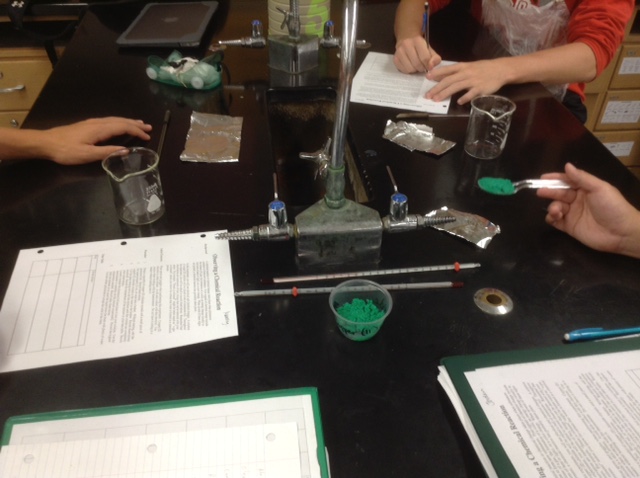
Group 3 performed an experiment. These students had demonstrated mastery on the quiz, so their work was an extension of our content. The lab was the chemistry standard of aluminum mixed with copper(II) chloride solution, but students were looking through the lens of a particle model of chemistry.

If someone would have told me a year ago that I would be managing three different simultaneous activities, where one was a lab involving chemicals, I would have balked, but the management piece was not as difficult as I imagined. The lab was short, so I had plenty of time to circulate among the three groups to offer help and clarification but also be vigilant as the chemicals were used. In the past, everyone had the guided notes whether they needed them or not. This year, students who showed they understood the content got to have a unique practice opportunity in the lab while students who were on the verge participated in a game to make practice more fun. For students who needed the guided notes, they were still available with the added model activity to check for understanding. The collaborative nature of the activities and groupings facilitated engaged, focused work.

The following day everyone worked in the lab, so every student still practiced these skills in the lab. In fact, the lab was due on the test review day and we had a lively discussion of particle models as we reviewed for the test. A quick look at yesterday's tests leads me to believe that the practice paid off, so I am looking for more ways to incorporate activities like these into my practice this year.

Monday, September 7, 2015

Making Time for Change

This weekend marks the end of my first ten days with students who have MacBook Airs as part of our 1:1 initiative this year. Overall, the first ten days have been good - the students are bringing their devices to class and they are charged and ready to go, for the most part. Some days we have used them a little, some days we haven't used them at all. In a perfect world, technology saves time. What I am struggling with, though, after these first ten days, is the time I am losing to using technology. How do I make time for this change?

On day 4 we do a quick review of the scientific method, followed by our first lab of the year. Because we had the MacBooks at our disposal, I used Pear Deck to gauge their understanding of what they read the night before. Pear Deck is great - kids sign on with their Google info, so it is fast - and can be used as an easy student response system. I wasn't really presenting information, just asking questions and seeing answers through Pear Deck. Where typically I might have just tossed out questions and called on a couple of kids, I could see everyone's responses. It was nice to share the responses I liked the best and highlight a couple of misconceptions, but, by the time they got to the lab, I was wishing they had about 7 extra minutes to complete that portion of class.

Then I missed a couple of days due to inservice. I wanted to make sure I knew what they understood from the days I missed, so I asked everyone to post their answers to a homework assignment to our LMS, Schoology. I also asked them to "like" a post that they knew was correct. Again, where I might have just asked a student or two to share, I could see everyone's answers - and so could the class, raising the ante for homework a little - but it took longer for them to type out their answers and read through some to find one to "like." Again that day I found myself racing through content to finish by the bell.

Last example: On Friday we did one of my favorite activities, determining the density of a bowling ball so we can see if it sinks or floats in water. I used one of my favorite tools, Nearpod, to introduce the activity. Students had to input answers to questions like "do you think the bowling ball will sink or float in water?" or "what measurements will you need to determine if the bowling ball will sink or float?" I used Nearpod's new instant question feature to redirect the students when their answers were incomplete; I would have missed that opportunity if I wasn't using this tool. Once the kids developed a clear idea of what they needed to do, they set off measuring and calculating. But the bell rang before we could test their predictions, so I had to put that off until Monday. Hopefully, the suspense is building.

I knew things might take more time this year, but I was expecting the obvious things: "I don't have my MacBook." "I left my MacBook in my locker." "My MacBook isn't charged." "Watch how slooooooowly I can remove this from my backpack while you try to start class." "I'll be with you as soon as I stop messaging with my friends." There really hasn't been much of that at all. All of the technology slowdowns have been a result of gaining more information while I am teaching, something I know I should be celebrating.

What are my takeaways of these first ten days? 


  • In each of these examples, I used technology because I had it. And I used it to check for understanding of the easiest content of the year. Maybe as the content grows more challenging, the time I spend to see a fuller picture of my students' understanding will feel like more of an investment. 
  • I have planned this unit using my pre-1:1 ideas and planning will need to change as I consider how my students and I will use these devices meaningfully. As I think about my second unit of instruction, I know I need to think about how my pace will change as I change my practice.

On this week's agenda is a reading quiz, delivered through Schoology. Then the students will complete one of three quick differentiated activities, based on their scores on the reading quiz. Without Schoology, it would take much longer to hand grade the quizzes and sort the students based on scores. Still, I am hoping for enough time at the end of class for a few quick demos to reinforce the reading with what feels like actual chemistry. Hoping for enough time. That's going to be a theme this year.

Friday, August 28, 2015

These Notes Look a Little Sketchy

Earlier this month I wrote about thinking about note-taking differently in my classes this year. That post shot to the top of my "posts most read" list since starting this blog about year ago. I'm not sure why it has been so popular. When I shared the described differences with my students, they weren't clamoring for more information. They had the same "ok, we'll take notes if we have to" looks on their faces that they typically have. Maybe one reason the post gained so much traction was my brief discussion of sketchnoting.

Sketchnoting is hot right now. There is no doubt about that. If you are following this trend, you know that sketchnoting is like purposeful doodling. At least that's how I described it to my students. If you haven't seen much sketchnoting, imagine taking notes in pictures and images, using words and pictures equally or even pictures dominating over words. My first sketchnote, such that it is, is pictured above.

I'm not a pictures thinker. That's not to say that I don't picture things; I do, vividly. When driving somewhere new, I picture where I am going. As I drive in to school, I picture my lesson in my mind. While reading or learning, I picture the ideas. When teaching, though, I am more likely to describe things than draw them because that's what I prefer as a learner. Still, with so much being written about making thinking visible, and the undeniable statistics that we are such a visual society, I know that this is an area where I could do some wandering and exploring.

So, as I started this school year, I have tried to take opportunities when I am a learner to sketchnote what I am experiencing. I started with our opening convocation delivered by our school superintendent and an amazing student at our school. Here is that sketchnote:

This week I attended two days of inservice. Day 1 was an extension of our district's focus on Marzano's work. We explored ways to use technology to enhance the art and science of teaching. Here is that sketchnote:

Inservice Day 2 was a thinking deeper about Marzano strategies day. There were many valuable insights that day, but I tried to save just the ones that resounded most with me. Here is that sketchnote:

And here's what I can say about sketchnoting so far:

  • I thought some of these looked pretty bad, but I have received many compliments, including this one (may favorite):
  • While sketchnoting, I find that I have to pay closer attention to the activity at hand. It is much harder to multitask, check my email, write tomorrow's quiz, and so on, if I am focused on recording the ideas in an artful way.
  • On the other hand, sometimes I am working so hard to make something look just the way I want it to, or at least as nice as it can with my cheapie stylus, that I miss something important like directions or reflections.
  • I need to use fewer words and more pictures.
  • I also need a better stylus.
  • It's a cool experience to try to encapsulate the ideas into just a few words and pictures. It's a great prioritizing experience and I am learning a lot about my takeaways by doing it.
  • I have attended a lot of inservices where I walked away with a packet from the power point. That packet sits on my desk for a while until I eventually file it somewhere and probably never look at it again. A sketchnote is more interesting to look at and takes up no space in my files or on my desk.

If you have been toying with giving it a try, I recommend it. I am only 4 sketchnotes into this, but I am going to keep working on this during this year. And to celebrate, I might just buy a fancy stylus tonight!

Sunday, August 16, 2015

I'm Gamifying my To-Do List

I am always on the lookout for a good to-do list app. Every one that I've tried is too complicated or too needy. I download new ones from time to time and try them out, but always abandon them for paper and pencil. My fave so far has been Google Keep. Simple, shareable, easy. But yesterday I saw another one that looked so funny that I downloaded it to try it out.

Quest is an iOS app for iPad or iPhone that you can use for to-dos or reminders or other similar task management. When you start using it, you get a pixelated 8-bit character. As you complete tasks and check things off your list (your Quests), you can level up your life and earn things for the avatar. It caught my eye because of the gaming quality. When my son was younger and didn't want to write his spelling words, I would sometimes draw him a scene where a truck would advance a certain amount with each word or a train advanced on a track toward the station. He is starting middle school tomorrow, so right after I installed Quest on my iPad, I installed it on his iPod.

It's easy to create tasks and lists of tasks with a swipe. As you complete tasks, you also swipe. The task turns into a jewel. Tap the jewel and you can see your level edge toward completion. My son was instantly drawn into the app and wanted to create tasks. Hopefully he will want to complete them as much as create them.


I like the simplicity of the app with ability to easily customize. The gamifying quality is a new twist on task management that will make keeping track of my to-dos more fun. Maybe grading lab reports will seem like a great accomplishment when I get a new outfit or weapon when I finish! Quest has many 5-star reviews in the app store. Reviewers suggest that it needs a way to add recurring tasks (that would be great) and a female avatar (I concur). Quest was free yesterday (and might still be free today). It requires iOS 7 or later. There is an Apple Watch app too. If you are ready to gamify your to-do list, check out Quest.

Friday, August 7, 2015

A Nearpod Update that is an Instant Improvement

It's no secret to anyone who has ever read this blog that I am a big fan of Nearpod. If you are unfamiliar, Nearpod is one part presentation tool, one part student response system. You import your slides and then add interactive components like quizzes, polls, drawing, websites, and more. This week's update made this already great tool even better.

Today at the SPARCC conference, I led a session comparing Nearpod and Pear Deck. I also compared them in a previous post. They are similar tools with many similar features. I like them both a lot and use them both in my classroom. Both combine slides with interactive components. Both export reports. Both integrate nicely with Google. Sometimes there is a tradeoff: Nearpod has better classroom management features, but Pear Deck allows teachers to ask questions on-the-fly, altering the prepared, planned lesson as necessary with spontaneous follow-up questions. But now Nearpod users can do that too.

With this latest update, instant questions and other components have come to Nearpod. While inside a live presentation, you click (or tap) the blue Nearpod at the top of the screen to see the instant options.

You can ask a True/False or Open-Ended Question, send everyone to a website or send an impromptu slide (complete with text or drawing or images from your files or Google), or send participants a Draw It slide. I love the idea that I can quickly draw something and send it out or take a drawing and screenshot it and send it to all the participants for corrections and additions. The ability to ask instant questions really increases the value of the tool because it implies that instruction is changing to meet the needs of the learners; it's not just a stagnant, pre-packaged plan.

I hate to sound greedy, but I would love to see polling added to the instant options. I love the idea of being able to ask students if they agree or disagree with discussion points or if they think a problem solving strategy would or would not work. I tried to use the True/False option like this, but you have to indicate a correct answer, so it has a different feel.

The app update also says that you can follow authors you like and receive notifications of when they have new content available. I haven't figured out how to do that yet, but, if you do, and you like chemistry, consider following me. As of today, I have 15 NPPs available in the store.

Tuesday, August 4, 2015

ReFlexing our Math Muscles


A couple of times this summer I have mentioned on my blog that we are working hard on math facts this summer with one of my kids. Both kids are changing schools this year and I am worried that we're not exactly math-fact-ready. We have tried a lot of things this summer - iPad and web games, flashcards, drawing visual representations of the facts. All were met with teeth gnashing and big sighing. The most recent addition to our math fact repertoire is a web tool called Reflex.


Reflex is a math fact fluency tool made by ExploreLearning, the Gizmos people. My school district has been a subscriber of Gizmos, standards-based math and science simulation tools, for over three years. As subscribers, we get a regular e-newsletter for Gizmos and Reflex. In each newsletter, the big gains possible with Reflex are highlighted. This is what made me try the 14-day trial. 

The first time we used Reflex, we were greeted by a funny crab who delivered directions. Numbers had to be typed as quickly as possible, probably to gauge how quickly a child could type a response. Eventually simple numbers turned into math problems. Step two was similar but in a different setting. A rabbit named Dwight invited simple number typing and then problem solving. Next a student pops balloons by answering problems. This allows a student to earn a ticket to Reflex island when games can be played after some coaching and puzzle making with a bear called Coach Penny. She gets us ready to play the games each day. Games allow students to earn tokens that can be redeemed in a store for clothes and other customizations for an avatar.

Dwight and Penny prepare students to play games on Reflex Island

There were many reasons this tool appealed to my child on Day 1. With all these layers and characters, you don't get bored. Even when you find something you don't like (we're not big Coach Penny fans over here), it doesn't last long and then the focus shifts, even though the work remains the same. The characters are unique and funny. Every time Reflex is "played" at our house, someone mimics Dwight the Rabbit as he explains that if we see a fact we don't know, we can "hit the space bah." The avatar is fun and customizing it brings a gamification quality to learning facts. The games played on Reflex Island are simple - the ninja game was a BIG hit over here - and emphasize mastery in a way that just feels like playing a game.

There have been many reasons that this tool has appealed to me so far. Each day a new element is introduced. New games are unlocked or new features are enabled or and the difficulty increases. Coach Penny does give a brief lesson, so some direct instruction of a rule or fact family is present. I like the focus on fact families. When 100% fluency is reached, it will be with multiplication and division of numbers 0-10, not just multiplication.

We're now on Day 11 and I am pretty impressed. From the teacher side of the tool, I love the reports that are available so I can see the progress from Day 1 to now. The fluency meter continues to rise every day, a fact family tree shows how many facts have been assessed and how many have been mastered, and I can quickly generate graphs that show fluency gains over time. I also like the milestone certificates that are generated. 

We have had a few setbacks. As the content increased in difficulty or games got harder, there have been tears. One way we combated that was to turn down the volume. This way it's easier to ignore the pressure of the timing feature - my children do not like to be timed - and the sometimes distraction of music and noises.

This great tool does have a cost. For home use, I'll pay $35 per student per year. On the one hand, that feels like a lot. On the other hand, in 11 days I saw big gains in fluency, so it feels like money well-spent to me. Which is good because our free trial ends in 3 days. I just wish my subscription came with a plush Crabby. Or that we could buy a plush Crabby. That sure would be nice tucked inside a schultüte in two weeks.