Tuesday, January 9, 2018

Whose Game for Chemistry? Science Ninjas Valence

Every since I read this post by the amazing Sara Vanderwerf, I have been kicking around the idea of a game table. Honestly, when I first read it, I thought that math teachers are so lucky that there are so many cool math games you could put at a play table. Then I read this post from A Mighty Girl blog. There is a game mentioned called Compounded that caught by eye. So I searched for it on amazon; the search lead to a lot of chemistry games. It turns out that chemistry teachers are also lucky that there are cool games for a play table. One I recently bought is called Science Ninjas Valence.

Science Ninjas Valence is a card game that plays quickly. Each player gets six cards from the shuffled deck. The rest of the deck goes face down and the top card is turned up. Players look at the element cards in their hands and try to make compounds - acids, bases, salts, water, carbon dioxide, etc. When you can make one, you discard your cards and pick up the compound card that you made. Each compound has a point value. The first player to ten points wins.

What I like about Valence:


  • The game plays fast. My eighth grade son and I played 4 games in 30 minutes on the day I got it.
  • It's good practice in adding up ionic charges to get a neutral compound.
  • There is chemistry involved, but if you don't know any chemistry, you can still successfully play (and will probably learn some chemistry). For example, If you don't know that a base is often composed of a metal, an oxygen, and a hydrogen, the base card is color-coded to emphasize that. After you play a while, knowing no chemistry, you will start to remember that an acid has a hydrogen and what a metal oxide is.
  • There is also some strategy involved. When you have to draw a card because you can't make a compound, you can choose from the deck or the discards, so the order that things are discarded is important.

The Science Ninjas who created Valence have also made a sequel game called Valence Plus. This one looks more complicated. And awesome. I'm putting it on my wish list!

This semester I am going to start putting out some chemistry games. Valence is going to be the first one. Stay tuned for how it goes!

Friday, January 5, 2018

Happy Retirement, g(Math)! Welcome aboard, #EquatIO!

image from texthelp.com
Yesterday g(Math), a popular add-on to Google apps for inserting math, was officially retired. This means it can no longer be downloaded and added on, and it doesn't appear in my list of add-ons any more. If you loved using g(Math), you will find much of what you used in the Chrome extension EquatIO which was developed from g(Math) by John McGowan with support from TextHelp. If you have never used g(Math), or EquatIO, read on for some details.

Install EquatIO from the Chrome store. If you're a teacher, apply for a free premium account after you install it. You must be signed in to Chrome to use the extension. This is one drawback for teachers who teach in many rooms with shared computers, but I don't think it's a deal breaker. Once you install it, you will find its icon at the top of your browser window, to the right of the address bar.

The premium account of EquatIO, free for teachers (thanks, TextHelp!), will allow you to add math to Google Docs, Slides, Sheets, Forms, and Drawings. The free version will only get you integration with Docs. Once inside a Google tool, click the EquatIO icon and a window pops up at the bottom of your screen. 


From that pop-up window, you can type in the math you want, use LaTex to code the math you want, use handwriting recognition to write the math you want, or use speech input to record the math you want. Then click "insert math." It's that easy.

Here is a quick video to show how the handwriting recognition works:


Here is a video to show how the speech input tool works. It's worth noting that EquatIO "listens" carefully to what you say and tries to only turn that math words into insertable math.

EquatIO also has a prediction feature for premium users. In this video I show a few things that are quickly predicted:

EquatIO also has a student response tool that I blogged about here. The retirement of g(Math) is really an evolution from add-on to Chrome extension, full of more possibilities and to be used in more ways. 

Monday, January 1, 2018

What Top Chef Taught Me About Teaching

Did you see this tweet on New Year's Eve?


I did, and just as my wheels started turning about how fun it could be, the tweet was quickly ratioed. The Math-Twitter-Blog-o-Sphere almost universally hated the idea. Math teacher Jamie Garner postulated that the idea could work and posted this good read to her blog. Other than Jamie, most comments read like Alice Keeler's opinions on homework.

I don't watch a ton of TV, but a few reality shows have captured my interest over the years. I jumped on the American Idol bandwagon after season 1, but was with Project Runway right from the start. This summer the viral Mandy Harvey video got me hooked on America's Got Talent. My unlikeliest love is Top Chef. Who wants to watch a show where you see food being prepared but don't get to eat it? It turns out, I do! Here are my takeaways from my reality show viewing:


  • You will have to step out of your comfort zone to create something spectacular.
  • But it's important to edit. Don't add so many elements that you lose your focus.
  • You will have to work in teams and your ability to do so will help determine your success. The people around you can influence your work and teach you great things.
  • It will be stressful. And there will be challenges that you don't see coming. Some will manage that well; some will not.
  • If you attempt this without much training or experience, the odds are not in your favor.
  • Reflecting on why something worked, or didn't, is a very important part of the process.


That list sounds a lot like teaching to me. Sometimes, as I prepare for a lesson or an inservice, I start telling myself to pare down, that I have too many ingredients in my dish!

I don't know exactly how the Great American Teach-off will pan out, but here's the show I would like to watch, Teach Your Way to the Top: Take a group of twelve amazing teachers with varied backgrounds and licenses. Give them a week to learn a technique or some content or whatever the challenge is. They teach every day and on the last day someone is eliminated. The week everyone teaches kindergarten, perhaps the calculus teacher struggles, but during chemistry week, maybe the preschool teacher has to dig deep. Change locations so we can see rural, urban, and suburban settings. Find a great host and expert judges. Film it during the summer so teachers wouldn't have to leave work to participate. Show the episodes during the school year so others could be edutained and inspired. Make the prize a great one.

A wise man once said that Math Class Needs a Makeover. Certainly others have said that about American education in general. Would a show like this provide that makeover? Absolutely not. But it might raise awareness of the successes and challenges in our education system. Because of Top Chef, I learned about food trucks and pop-up restaurants. I didn't know that chefs carried around their knives as their most important tools. I didn't know that salt, fat, acid, and heat can be considered the 4 elements of every great dish. I didn't know about the training or artistry that a chef brings to his dish. And I certainly couldn't have named any famous chefs past Julia Child. Perhaps if people tuned in to Teach Your Way to the Top, they might learn more about the time we devote to our craft, the importance of content standards, the reasoning behind a new pedagogy, and the inequity inherent in American education. And understanding and awareness might pave the way for needed reform and innovation.

Tuesday, December 12, 2017

Argument-Driven Inquiry

I spent a terrific day today learning about Argument-Driven Inquiry (ADI). This topic has been on my to-learn list for a while, so I was anxious to participate. It was a great hands-on day and while I don't feel like an expert, I am looking for a time when I can implement this technique in my classroom. Here's my rundown.

Argument-driven inquiry is an instructional model for science teachers to use with labs. Through an 8-stage process, students develop an argument and then read, write, speak, and listen their way to supporting it. In the workshop today we tried each of the stages. They include:


Stage 1: Identification of the Task & Guiding Question

Introduce the idea or concept and the guiding question for the task. At the workshop today, we were asked to consider how we could use a lever maximize the jump height of a figure.


Stage 2: Design a Method & Collect Data

Using a planning form, students develop a testable hypothesis and experiments. Then the experiments are conducted. My group investigated the effect of mass of a dropped object, distance of the figure from the fulcrum, and mass of the figure.

Stage 3: Analyze Data & Develop a Tentative Argument

Use a whiteboard to record the guiding question, the claim, the evidence (including a graph of data), and a justification. 

Stage 4: Argumentation Session

Using a round robin style, some members of the group stay with the board and present the ideas while others visit other groups and hear their ideas. There are "back pocket cards" that can be used to help students ask good questions as they listen to their peers.

Stage 5: Explicit & Reflective Discussion

A full class discussion gives students the opportunity to reflect on what they saw at all the whiteboard stations and link ideas from the experiment to what they are learning or have learned in class. Content could be explored in depth here.

Stage 6: Write an Investigation Report

The investigation report focuses on 3 questions: 

  • What question were you trying to answer and why?
  • What did you do to answer your question and why?
  • What is your argument?

The report is 1-3 paragraphs long and could be written in about 25 minutes.

Stage 7: Double-Blind Group Peer Review

Students use a feedback form to work as group to provide feedback to anonymous papers. The feedback form has very targeted questions to focus students on helping peers to successfully defend and explain their ideas.

Stage 8: Revise & Submit Report

Students use the feedback from stage 7 to make changes and submit a final copy to the teacher for evaluation.

ADI is a research-based instructional model that gives opportunity to practice science content standards, nature of science standards, and literacy standards. Lab manuals are available to help teachers get started. The website includes resources for using this model in your classroom - materials for instruction, to scaffold, and assess. There is also an online course that takes about 6 hours to complete and is a good introduction. 

This is definitely a model I want to explore more and try to implement in my classroom during second semester. Stay tuned for more posts about my attempts.

Monday, December 4, 2017

Quizizz: Fast, Fun, Free, Fresh

It's no secret that I am a big fan of Quizizz. In fact, I have blogged about this awesome formative assessment tool seven times, the last time almost exactly a year ago. My most popular post is a comparison of Quizizz, Kahoot, and Socrative. In October and November each year I ask my students to memorize some chemistry content. I begin each class with Quizizz to try to encourage them to work on chunks of this content little by little. 

My students always seem to enjoy playing this quiz game. They quickly become accustomed to going wight to join.quizizz.com at the beginning of each period. Our results weren't terrific as we neared the test this year, so I used Quizizz to create one last game as an optional homework assignment. I didn't even say too much about it in class. I told the students it would be there if they wanted to use it to prepare. I provided the link and PIN on our LMS. It's worth mentioning that I also provided a link to a Quizlet deck and a couple of other web tools.

I checked the data from this optional homework assignment recently and was quite surprised by what I found. Despite the fact that it was optional, and that I said very little about it class, the game was played 42 times! Several students played it multiple times. One student did it nine times! When students are willing to use an optional tool, especially multiple times, that is a testament to its engagement.

Quizizz is almost ready to debut a new look to their tool. Currently users can opt in to the new interface but the old one will go away soon. The new one boasts many advantages, including better navigation, easier searches, and improved reports. Google Classroom integration has been around for a while, but now when you create a Quizizz and assign through Google Classroom, the data will show up in Quizizz AND in Classroom. Nice!

Quizizz is also having a #NameYourAvatar contest right now on Twitter. Name one of the recently redesigned avis and you could win a gift card! 

New interface, Twitter contest, high engagement - whatever your reason, this terrific tool is worth a look today!

Tuesday, November 28, 2017

Hooray! Free Premium EquatIO for Teachers!

Earlier this fall, I wrote this post about EquatIO, a Chrome extension that makes it easy to put mathematical symbols or equations into Google (and other) apps. EquatIO was built to take the place of the Google add-on g(Math) that has recently retired. 

There are free and premium versions of EquatIO. Today, texthelp announced free premium subscriptions of EquatIO for teachers! In short, with the premium version, teacher get free access to integration in Google drawings, forms, sheets, and slides; math and chemistry formula prediction, unlimited handwriting recognition. Plus, as new features, like the recent addition of the interactive MathSpace, become available, teachers will have free access to those, too.

In order to take advantage of this tremendous offer, install EquatIO. Then fill out this form to request free teacher premium subscription. Be sure to use the same email address to install the extension and to request free access.

Thanks, texthelp, for your commitment to giving all teachers access to great tools!

Monday, November 6, 2017

What's It Worth To You?

I was sitting in my study hall duty with a friend and we were both grading papers. He was muttering as he worked about how it would be impossible for him to make the class any easier. Intrigued by this, I asked him to elaborate. He explained that his tests were worth 40% of the students' grades and that if they just paid close attention to the study guide when preparing, they were sure to pass the test. I knew his comments were about the study guide and the test, but I was curious about the other 60% of the grade, so I asked. The other 60% was a notebook check. Upon further probing, I learned that this meant that students needed to have all the papers from the class in a notebook, maybe in a particular order. I remember asking him, "if you keep all the completed papers in the correct order in the notebook, you could just opt out of the tests and still pass the class?" His response: I have never really thought about it like that.

At the school where I teach, we have just wrapped up first quarter and parent-teacher conferences. In an effort to help students improve their performance in my class, I ask them to do a bit of reflective thinking: How did I perform in each area of the class? In which area could I improve? How will I accomplish that improvement? Likewise, I am doing some reflective thinking about my practice, especially in the area of grades.

I classify my assignments in chemistry as tests (40% of the total grade), labs (25% of the grade), quizzes (25% of the grade) and a miscellaneous category (10%). During first quarter, I evaluated 25 assignments for 620 points - 2 tests, 17 labs and quizzes, and 6 miscellaneous assignments. A pie chart of assignments in my class might look like this:

I have deliberately structured these assignments and categories so that tests are a big deal, but they aren't everything. Labs and quizzes together are worth more than tests and there are many more of them. Students encounter and practice a concept about five times before they are tested on it; they receive formal and informal feedback several times leading up to the test so that they can have a keen idea about their progress.


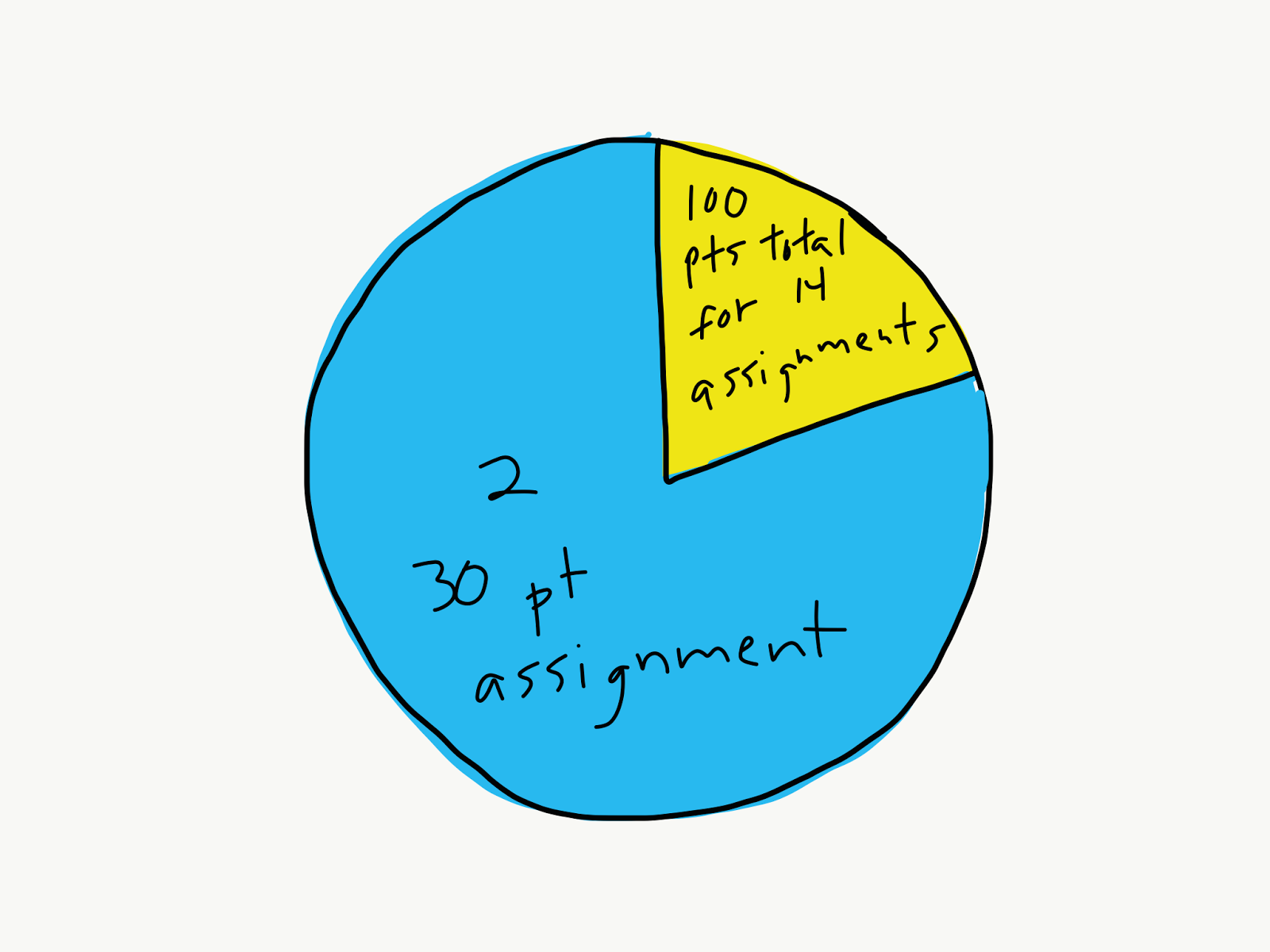
Lately I have become aware that my system isn't the norm. In both of these examples with computer-weighted categories, 80% of the grade in the class is based on two assignments; 20% of the grade is based on several smaller assignments that often appear to be graded on completion. In both of these systems, if the computer-weighted categories were removed and a grade was recalculated using only the points each assignment was worth, the grade could change a great deal.


I have a lot of questions about these grading structures:

  • Why is so much of grade dependent on so few assignments?
  • How do students know how well they understand a concept if they are not formally evaluated between the birth and test of a concept?
  • Is it realistic to think that most students will accurately self-evaluate their progress during a unit of study based on completion assignments?
  • Does this type of structure generate concerns about homework that isn't helpful or test corrections and retakes?
  • Are there other types of assignments that could be used to measure progress? Is the continuum only high stakes tests for 80% of a grade or completion activities?
It seems a commonplace perception that education has become too focused on standardized tests. Why, then, would teachers choose to emphasize [non-standardized!] tests so much over other types of assignments within their classrooms?

Much has been written about the ways schools assign grades and whether or not grades accurately represent what students know and are able to do. In my building we overhauled our grading policy about about ten years ago, partly in response to the book "A Repair Kit for Grading: 15 Fixes for Broken Grades." Taking many of the author's suggestions into account doesn't answer my questions about grading schemes that magnify one or two assignments.

In my teacher preparation, no time was spent discussing how many points assignments should be worth, how many assignments make a valid measure of student progress, or how to appropriately weight measures to reflect student progress. That's definitely a discussion that I hope will be ongoing. 

How do you organize and weight your assignments? Is it working? Please comment and join in the discussion.